






Economics prize winner on Sweden: Your past success is your biggest obstacle
COLUMN: Sweden is one of the world’s most innovative countries. But that is no longer enough. Economics Prize laureate Philippe Aghion argues that Sweden and Europe need to become significantly hungrier for innovation otherwise both companies and talent risk moving to the US or China.
It is easy to believe that a country like Sweden has an advantage that is almost impossible to lose.
We have built global companies, developed technologies that have changed the world, and created a model that combines innovation with social security.
But according to Philippe Aghion, one of the recipients of the 2025 Swedish Central Bank Prize in Economic Sciences in Memory of Alfred Nobel, there is a danger in precisely that success.
You can become too satisfied with what you have already created.
When I met Aghion in Stockholm ahead of his lecture at the Nobel Prize Museum, he was clear: Sweden has a lot to be proud of, but it must continue to challenge itself.
Aghion’s research focuses on what he calls creative destruction: new innovations drive growth by replacing old technologies, companies and business models.
It sounds brutal. But according to Aghion, it is precisely the engine of economic development.
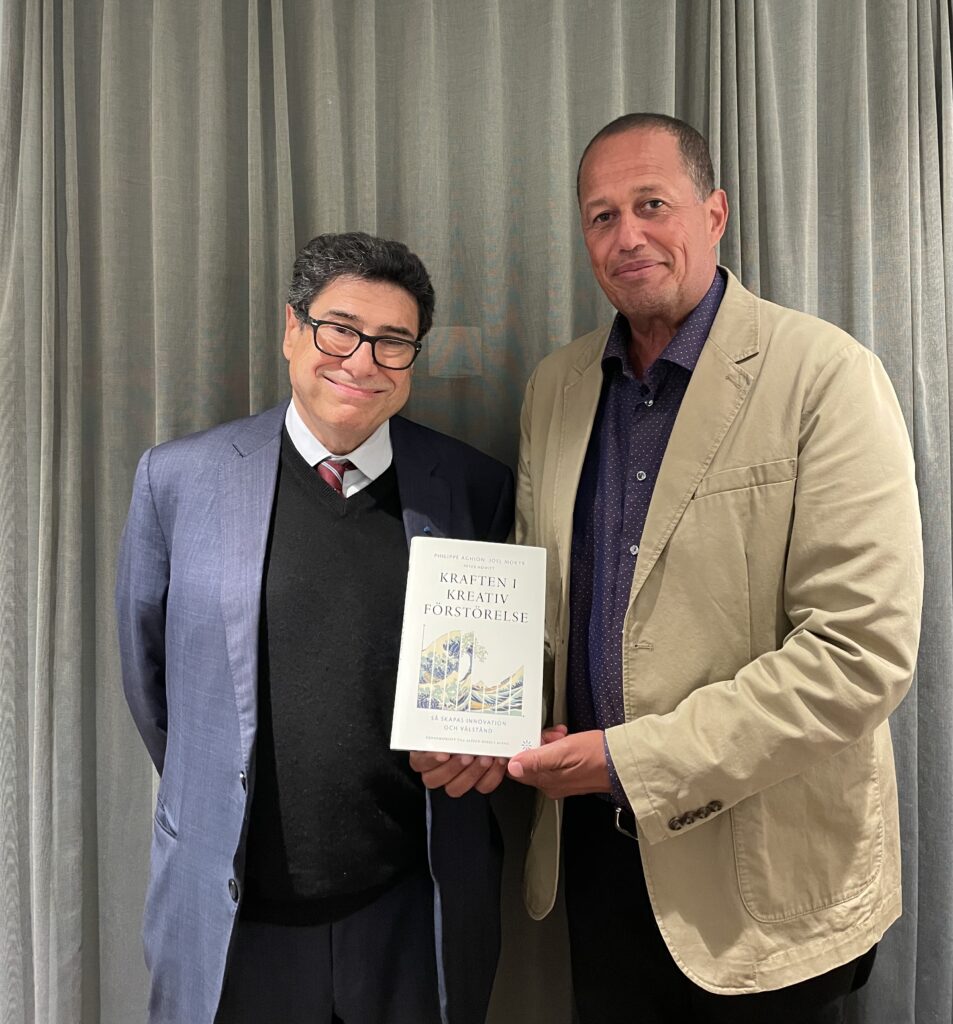
Economics Prize laureate Philippe Aghion has researched economic growth and has just released a book describing the power of creative destruction. The photo is with Dagens PS columnist Stefan Engeseth. Photo: Dagens PS
The problem arises when companies that were once innovative begin to protect their position.
“Sometimes you can rest on your laurels,” he says in the interview. The solution, according to Aghion, is to constantly expose established companies to new competitors.
“It is important to have new blood, new minds and new ideas challenging them.”
Established companies are then forced either to continue developing or to make room for new companies. This is where Aghion sees a problem in Europe.
Sweden has innovation but lacks hunger
Aghion describes Sweden as a country that has been unusually successful at combining innovation, social mobility and a strong social system.
But when I ask whether Sweden is truly hungry enough for innovation, he agrees that there is reason to wake up.
“We need to become hungrier for innovation.”
He points in particular to a European problem: too little venture capital, too little long-term research funding and insufficient opportunities for new companies to scale.
This applies to Sweden as well.
Talented people can start companies here, but when those companies need larger amounts of capital to grow, they risk ending up elsewhere.
“They go where they can develop their innovation,” Aghion observes.
And that means Sweden could lose perhaps the most important thing we have: talent.
Europe needs both competition and industrial policy
Aghion is also critical of how Europe has approached industrial policy.
He argues that, in its pursuit of competition, Europe has in some ways gone too far in the opposite direction, thereby limiting active industrial policy.
The US is an example of the opposite approach.
Aghion highlights DARPA, the US Defense Advanced Research Projects Agency. It played an important role in developments that later contributed to the internet and the IT revolution.
His conclusion is clear: Europe needs both competition and an industrial policy that actively helps new technologies emerge.
One must not replace the other.
Failure must become less dangerous
But money and institutions are not enough. Aghion repeatedly returns to culture.
According to him, the US has a stronger culture of trying, failing and trying again.
Europe finds this more difficult.
“You have to try and fail. Failure is not a problem,” he says.
It starts at school. Aghion wants to see a culture where children learn that it is okay to try things that may not work.
It is difficult to create radical innovation if everyone is afraid of making mistakes. And here comes an unexpected part of his reasoning: Aghion argues that even a certain degree of ignorance can be good for innovation.
At the frontier of research, we do not know the answer. “We have to work on things we don’t know.”
Sweden needs both tradition and revolution
When I ask whether Sweden may have become too comfortable, Aghion is nuanced.
He does not think tradition is a bad thing.
On the contrary, he likes the combination he saw during Nobel Week: young people presenting new ideas while Sweden holds on to ceremonies, history and traditions.
The problem arises when tradition starts to prevent change.
Aghion believes that a certain degree of conservatism can be healthy. We need to understand what previous generations have built. But it must not paralyse us.
Perhaps that is the most important lesson for Sweden right now.
We can be proud of yesterday’s innovations, but they give us no guarantee for tomorrow.
Aghion describes himself as a “fighting optimist.”
Not a naive optimist, but someone who continues to hope as long as there is still something left to try.
And his message to Sweden is actually quite simple:
“Keep what works. But dare to destroy what is no longer enough.”
Because creative destruction is not a threat to success — it is the price of keeping it.
Text: Stefan Engeseth. Originally published in Swedish by Dagens PS. English translation by AI.