


Press clip: We can no longer afford to be this stupid
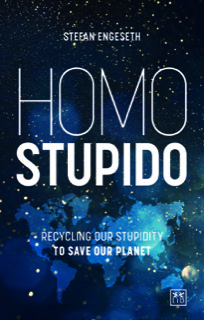
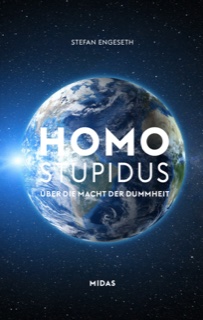
We humans are technologically smarter than ever. Yet we continue to start wars, destroy nature and repeat old mistakes. In his book Homo Stupido, futurist and author Stefan Engeseth explores why we find it so difficult to learn from history – and how our human stupidity could instead be used to create something better.
The question of human wisdom – or the lack of it – has followed Stefan Engeseth since childhood. Already at the age of eight or nine, he started protesting during history lessons when his teacher talked about the First and Second World Wars.
“I couldn’t believe that human beings could wage war like that. I asked whether we were just going to wait for a Third World War. Eventually, the headmaster called my parents and told me to calm down.”
But Stefan never stopped asking why. Today, Stefan Engeseth is a futurist, guest professor and author. For many years, he has interviewed researchers and decision-makers in fields including AI, psychology, evolution and innovation. Homo Stupido, published in 2025, took eight years to write.
The starting point is provocatively simple: humans like to see ourselves as intelligent, but our actions do not always support that view.
“We are highly intelligent technologically, but at the same time, we are stupid. We destroy the planet and we are not very good at learning from our mistakes.”
We need to recycle our stupidity
Engeseth uses the concept of “recycling our stupidity”. It is not about accepting stupid decisions, but about having the courage to acknowledge them, analyse them and use the experience to avoid repeating the same mistakes.
“We need to recycle our stupidity into something good. Perhaps we could afford it in the past, but we can’t anymore. Our weapons have become too dangerous, and we have lost our connection with nature.”
He compares humans to lion cubs. When they are young, they fight and bite each other, but as they grow older, the behaviour stops. Humans, on the other hand, seem capable of continuing their conflicts generation after generation.
At the same time, Engeseth does not want to paint a hopeless picture of the future. On the contrary, he repeatedly returns to human creativity and our ability to innovate. The same intelligence that can be used destructively can also be used to solve problems.
“Imagine if the enormous expertise of the weapons industry could instead be used to develop technology that restores nature and creates new forests.”
Older people hold knowledge we need
According to Engeseth, an important part of the future concerns something that is easily overlooked: experience.
He talks about encounters with indigenous communities where older people have a natural and important role in society. For example, elders can observe children while they play and identify their different talents. In this way, knowledge can be passed between generations, helping young people discover their strengths and their place within the group at an earlier age.
“We should have abolished ageism a long time ago. It is stupid in itself.”
In a society where so much emphasis is placed on what is new, Engeseth believes we risk throwing away a significant resource when people leave the workforce. Decades of experience, mistakes, intuition and professional knowledge can disappear without anyone preserving them.
Interestingly, this is where he sees artificial intelligence as an opportunity.
“AI could be used to preserve the knowledge of different generations. It should almost be illegal to die without passing on your knowledge and experience,” he says with a laugh.
He points, among other things, to languages that are disappearing. When a language dies, stories, history and knowledge about how people have lived are also lost. With new technology, more of this could be documented and passed on.
AI can make us both smarter and stupider
But Engeseth’s view of AI is far from uncritical.
“The brain is like a muscle. If we use AI in the wrong way, we risk becoming more stupid. But if we use it to awaken curiosity, we can become smarter.”
Technology itself is neither good nor evil, he argues. He refers to Professor Yuval Noah Harari, who often compares AI to a kitchen knife: the same tool can be used to cut bread or as a weapon.
The development of AI is also moving faster than legislation and social norms can keep up with. That is why safety and discussion about how the technology should be used are essential.
“It’s good to use AI. But not if AI is using you.”
At the same time, there are human qualities that he does not believe technology can replace. Above all, these include intuition and emotions. In the future, he therefore believes that the ability to understand other people and collaborate may become even more important.
Experience must not become an obstacle
But does having many years of life automatically make someone wiser? Not necessarily.
Engeseth warns that knowledge and experience can also make us less open-minded. Someone who knows how something has always been done may find it harder to imagine how it could be done in the future.
“The future is invisible. We need to be able to visualise it and not lock ourselves into what has been.”
This is why the combination of generations becomes interesting. Older people have experience and can recognise patterns. Younger people can bring different perspectives and question things that have long been taken for granted.
Engeseth would like to see schools train children more in precisely this area. He talks about future literacy as a possible school subject, but also about the need to strengthen children’s self-confidence, curiosity and social skills.
He himself has retained much of the questioning boy who once upset his teacher.
“My boldness has taken me forward and taught me to take the hits. Everything is a learning experience.”
And perhaps that is where the essence of Homo Stupido lies. Stupidity can hardly be eradicated. Humans will continue to make bad decisions and mistakes. But we can become better at acknowledging them, learning from them and passing the experience on.
“I am curious about everything and I ask a lot of questions. The more you learn, the more you understand. Knowledge creates humility.”
For Stefan Engeseth, the future is therefore not just about smarter technology. It is equally about whether we humans can become better at using what we already have – our experience, our creativity, our curiosity and each other.
Text: Inger Söderholm. Originally published in Swedish by SuperSeniorerna. English translation by AI.